
To see Jesus in, behind, through, beside, and with all people. That is contemplation, but it is contemplation of a particular kind. It’s a defining characteristic of contemplation on the muddy roads of the world, because it’s definitely a contemplative thing – for it involves especially contemplative Gifts of the Holy Spirit such as Knowledge – but it is also more a “worldly” thing than a “cloistered” thing.
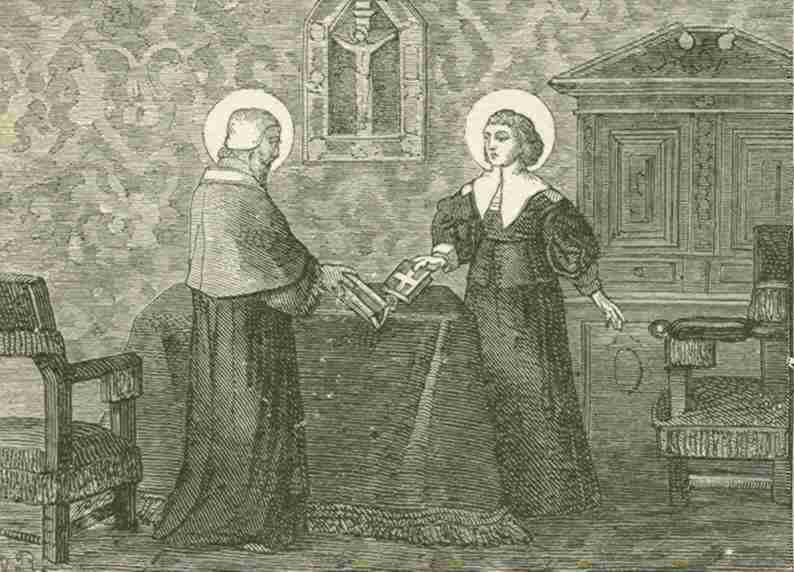
Francis de Sales expressed a wish that someone – or many someones – come along and develop writings on this aspect of the faith. There have been many: Charles de Foucauld, René Voillaume, Jacques Maritain, Marcel Văn. One whom, until recently, I didn’t know had worked at this was Francis’ own close friend, Saint Jane Frances de Chantal. A few short years after her friend and co-founder’s death, she was writing to her Visitation sisters about this same topic. The Visitation sisters were to be a contemplative order whose cloister walls were the limits of love itself. As a result, of course there had to be an amount of contemplation on the roads and an amount of seeing Jesus in all people and events of providence.
Saint Jane is talking about finding postulants and novices:
May these souls have such a pure, upright intention that they do not waste time worrying about created things – their friends, their appearances their speech. Without stopping at such considerations or at any other obstacle they may meet along the way, may they go forward… seeing in all things only the sacred face of God, that is, His good pleasure.
In a kind of practical detachment lived on the roads, we “don’t stop” at the consideration of created things but “see in all things only God’s sacred face”; the meaning, I think, is clear. We know in a first step that these things have created value in themselves; but that doesn’t delay our consideration of the deeper value, what we “only” see. The infinite distance between stopping at the creature and continuing on to God’s sacred face (Live Jesus!) is emphasized. Jane also emphasizes that this is a very fast way to holiness:
This way is very narrow… but it is solid, short, simple, and sure, and soon leads the soul to its goal: total union with God. Let us follow this way faithfully. It certainly precludes multiplicity and leads us to that unity which alone is necessary.
No doubt she is emphasizing that this way of seeing Jesus in all people and things is a fast way of progress in the spiritual life. But what is the reason for such progress? She does give one, and, in my opinion, it’s very deep and explains the matter very well.
Seeing Jesus in all things “precludes multiplicity,” says Saint Jane, “and leads us to that unity which alone is necessary.” When she says “that unity which alone is necessary”, Jane is obviously referencing the Gospel “one thing necessary” (Lk 10:42). And it’s unity of life. Indeed it is. It’s unity of action and contemplation, action progressively taken up into contemplation, for God is in all things and especially in all people (Mt 25:40). To see this is to act differently – at least in intention and progressively more and more united to God, more and more transformed in him, and tending more and more towards the goal.
Seeing Jesus in others and in events is contemplation for those whose cloister walls are the limits of love itself; it leads to virtue (for she who sees Jesus more and more in people must act virtuously more and more); it leads to unity of prayer and action; it leads to simplicity of life, without duplicity and without rash stupidity either; it is a narrow way, but it is “solid, short, simple, and sure,” taking the soul rather quickly to God, for the soul wants to spend every moment with him.


 Contemplative in the Mud