

The interior sufferings of Jesus, as a child, were greater than the exterior sufferings of Jesus in Holy Week. Really: the interior sufferings of the child Jesus “outweigh”, so to speak, the exterior afflictions and sufferings of Jesus’ Passion. This is something that Marcel Văn says in his Conversations with Jesus, Mary, and Thérèse. As we enter Holy Week, let’s check out what exactly Marcel says, what he means, and whether it’s true.
Towards the end of April 1946, while in his novitiate year with the Redemptorists in Hanoi and writing down his familiar “conversations” with Jesus, Mary, and Thérèse, Little Văn had a silly thought:
This silly thought came to my mind: all the external suffering that you have endured from the moment of your arrest until your last sigh on the cross, even all these sufferings, I say to myself, are not comparable to the least interior suffering that you send me…
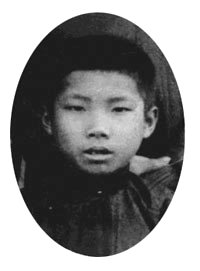
But this silly thought, directed at himself and the way Jesus, in his wisdom, treats Marcel, doesn’t stay long focused there. It quickly occurs to Marcel that it’s even more true of Jesus:
Ah! Little Jesus, I love you. You suffered much more interiorly than externally.
The key phrase here is Little Jesus. Marcel is not only thinking of the interior sufferings of Holy Week. He is actually intending to talk about the interior sufferings of the Holy Child Jesus, of “Little Jesus”. This is emphasized by some words of explanation and clarification given by Jesus some days later:
If your father Saint Alphonsus had not loved me as a child, if he had not understood my life as a child, neither would he have been able to understand the death that I endured on the cross.
We are certainly talking about the necessity of seeing Little Jesus’ world – and, by extension, Little Jesus’ sufferings. Jesus adds,
The outward sorrows endured until my death are nothing compared with the interior pain that I left in childhood in thinking of the sufferings I would have to endure later.
Marcel! It is easier to suffer in the present than to think of the sufferings that one will have to endure later.
What is this “suffering in the present” that is greater than suffering in the future? Surely it is not an act of worrying about the Divine Providence. We know for sure (Mt 6:25–34) that this is excluded. But it is also possible, for the Agony in the Garden, while part of the Passion of Jesus, also comes before the arrest. Although much closer to the time, this is a “suffering in the present” on behalf of the future. What then could such “suffering in the present” be? Surely it is simply knowing that this suffering is necessary, that it has a cause (our own sin and evil), that it will reveal the interior of others’ hearts. And that, for Little Jesus whose heart is all Love, is suffering indeed.
 Indeed, we have a glimpse of the Church’s attitude towards this truth in the icon of Our Lady of Perpetual Help: Jesus is shown the instruments of the Passion as a young child. For what reason? Because, surely, he suffers interiorly for this at all times, not discontinuously only at his Passion, but in his entire living humanity.
Is it true that the least interior suffering is greater than all of Jesus’ external sufferings? Yes, of course. The two are linked, connected, not absolutely cut off one from another. But interior suffering is always greater because it occurs in the spiritual part of a person. It is like asking whether a child’s rough knowledge of things is greater than a well adapted, clever dog’s, elephant’s, or dolphin’s. Yes, it is. Always. It has passed through the spirit; that is enough. Or we could think about the fact that obedience, which is a kind of penance of our intellect and judgment, is greater than bodily works of penance. The logic is the same. It is the same with suffering. The least interior, spiritual suffering of Little Jesus in anticipation of knowing that others’ sin will be made known is greater than his external suffering in Holy Week. (Indeed, as John of the Cross and Marcel both assert, it is this interior suffering which is more properly the cause of Jesus’ death than his external suffering.)
How much Jesus loves us and did from the moment of the Incarnation to his Death! It is a great mystery. And it’s true: if we don’t really appreciate the depth and the prolongation of the mystery into Nazareth and Jesus’ childhood, do we really understand the Cross?


 Contemplative in the Mud