
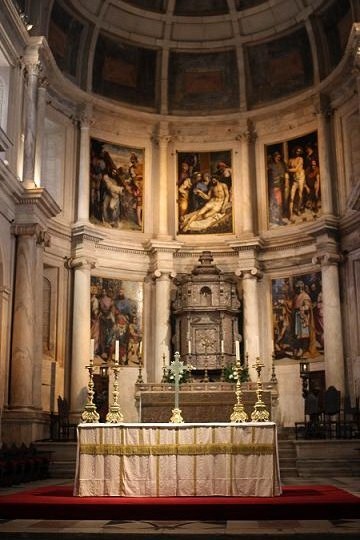
When it comes to discussing the Eucharist, there is a line of reasoning that sits very uneasily with me. I don’t like it. I don’t like it at all.
This line of reasoning is often found in Fathers and Doctors of the Church, arguments by laypeople, and especially arguments by apologists (and especially modern apologists). If I take a version from Saint Alphonsus, my spiritual father, no one will doubt that I am taking the quote from someone I love very much; I’m not taking the quote to stir up trouble. This is a real issue. The formulation that concerns me goes something like this:
And so that everyone could easily receive him, he chose to leave himself under the appearance of bread. If he had left himself under the appearance of some rare or very costly food, the poor would have been deprived of him. But no, Jesus wanted to place himself under the form of bread, which costs little and can be found everywhere, so that every person in every country can find him and receive him.
Starting with the first thing that bothers me, we have the notion that “the form of bread… can be found everywhere”. This isn’t true. In actual fact, bread can certainly be found everywhere where Christianity is exported to; which is to say, everywhere where a cultural form dependent for its very life on the cultural form and spiritually rooted personality of ancient Israel can be found. Elsewhere, bread may or may not be found. It’s not certain. Saint Alphonsus, or any other Westerner, who makes these claims really must be ignorant of how uncommon and how much of a more expensive, semi-luxury food item bread can be, even today, in many Asian countries:
- If a particular bread item is mentioned, people in Thailand invariably link it to the Portuguese or French arrivals. And, because Thailand was never colonized and never converted to any Christian religion beyond the level of 1% of the population, the idea of making lots of bread never caught on. In the 21st century, bread is still enough of an outside foodstuff to draw obvious historical lines back to Portuguese and French missionaries and diplomats.
- It costs me more to buy bread here in Thailand than in a Western country. The price difference, in absolute value, is about two or three times. Meanwhile, the mean monthly wage is on the order of ten to twenty times less than in the West, with people working longer hours. No, my father Alphonsus, “the form of bread” cannot be found “everywhere” and it does not universally “cost little”.
When this is validly pointed out, the tone of many an apologist is frankly offensive and sinful. (I am not talking about my father Alphonsus here, who must have been truly ignorant of the state of affairs in the world, and whom I expect would retract his universal claims if the particular facts were pointed out to him.) When confronted with the socio-economic facts, many people point out “exceptions to the rule”. This is nonsense. If someone is trying to show that a practice of the Catholic Church is truly catholic by showing that it can truly be universal, then he has to live with the consequences. In this case, the consequences are failure.
In point of fact, the catholicity of the bread in the Eucharistic sacrifice has nothing to do with the geographic and social universality of bread. Thank God! Because this human-geographic and economic universality is a figment of imaginations.
In point of fact, the catholicity of the bread in the Eucharistic sacrifice actually has to do with what “catholic” really means. The Catholic Church is “catholic” in the sense of “according to the totality”; this doesn’t mean “according to a flat universality”. That would be utter bosh. “According to the totality” means “according to the totality of Jews and Gentiles”. Gentiles are grafted onto the Jewish structure and root (Rom 9–11). The origins of the Eucharist are Jewish. It is a sacrifice, it is a Passover meal, it is consumed by the priest in the “temple”, it is finished and completed in Communion, it is food from heaven like manna. Gentiles are grafted into this narrative, and that is what makes the choice of bread and, in particular, unleavened bread (if possible) to be catholic. Of course, as Saint Hildegard was fond of pointing out, the whole of creation rejoices in the Eucharist, in its various ways and abilities; but as far as the rite itself and its choice of material goes, it is not flatly universal, for creation itself is not flatly universal! It is a rite that is “according to the totality of Jews and Gentiles”. It accords with the totality of the two bodies whose separating wall has been removed (Eph 2:14) so that they can be knit together into one Body of Christ – which, in fact, the Eucharist effects.
Now…
Let me say the one thing towards which my thoughts are heading.
It is possible to be mistaken about the facts. It is possible to be confused that bread isn’t always and everywhere available and cheap. That can be a question of human experience, exposure to other cultures, and social, geographic, and economic facts. These failings aren’t necessarily sinful.
But to be stubborn in the face of the facts – or to prefer a “universal” theory to the facts – is actually a matter of grave sin. Yup, a matter of grave sin. Why? Because it’s a rebellion against our Jewish roots. Jesus didn’t institute the Eucharist in reference to any universal human practices. He instituted the Eucharist within the Jewish tradition to which his Holy Family belongs. The catholicity is found there. Ideas about the universality of bread are bosh. The real reason for the use of bread – as any Christian living faithfully in a rice-based, rather than wheat-based, culture knows – is historical. It is because Christians are grafted on to the original and still-existing Jewish root. Any incidental “universality” of bread is just that: incidental. It’s nice if bread is cheap. And it’s cheap wherever Mediterranean culture has made its mark. But this is not a given, universal reality. And the Gospel is not based on anything as flimsy as a “universal” reality that is not, in truth, universal.
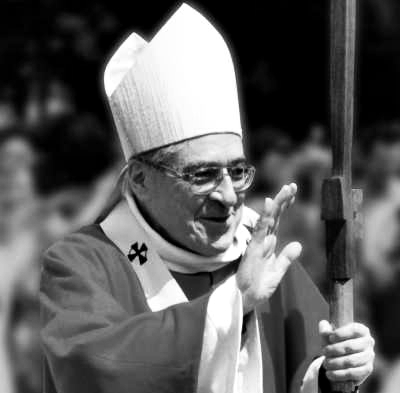 In this context, I want to introduce a quote, seemingly paradoxical, of Cardinal Lustiger’s:
The real difficulty to hear this Word of God made flesh is not found in differences of culture and of civilization, but in resistances that oppose us to the love to which we are called by this Word.
On the face of it, perhaps I might think this quote condemns those cultures which do not hear and respond to the Word. Perhaps. But if we pay closer attention, we notice something else. There is the stark recognition of real differences in culture and civilization. There are genuine differences that subsist in the human dough. And one of those is bread. Bread is not a universal thing. It belongs to certain civilizations. That is real. But in the Gospel and in love we can get past this difficulty as regards the Eucharist and incorporation into Christ’s Body via the Eucharist. Why? Because rice-based cultures are not the “odd man out”. Every non-Jewish culture must recognize its place as being, spiritually, dependent. This is not a unique problem of rice-based cultures. In fact, all Gentiles must simply be grafted in, grafted on, to the original and still-existing root of Israel. That’s what Christianity, in its catholicity “according to the totality of Jews and Gentiles”, is about. Christianity is not a “universal” wisdom (God forbid!); it is an historical plan of God’s, showing a kind of particularity in this plan that begins with one people and then takes in the whole world.
If we tried to substitute universality for real catholicity, we’d end up saying silly things like, “Bread is available everywhere and is not costly.” In fact, by forgetting ancient Israel, we forget modern Asia. By forgetting our particular beginnings, we forget other neighbours. By forgetting the only real cultural reason for bread (this reason is Israel), we forget the distinctions of other cultures. It’s inevitable.
The Catholic Church is catholic. She’s not universal. She’s “according to the totality of Jews and Greeks”. This affects a myriad of apologetic arguments. If I pick one that focuses on the Eucharist and on Saint Alphonsus, it’s because regular readers of the blog know that both of those choices are out of love for the subject matter.


 Contemplative in the Mud