
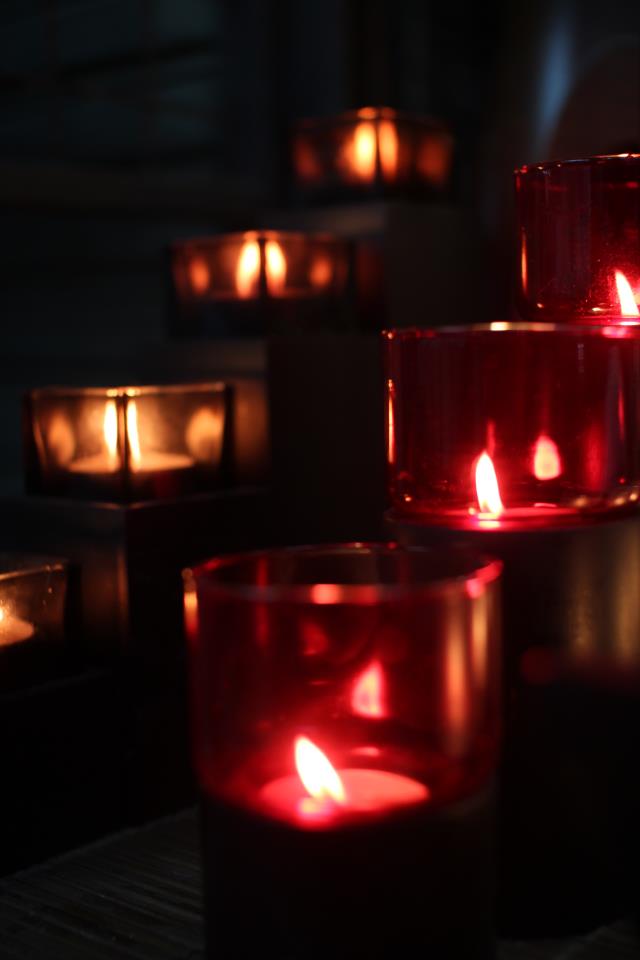
Fire. It is an image of the Holy Spirit. It suggests burning. It suggests something that is beyond our control. (Indeed, to the scientist like me it suggests images of fractals and “chaos” and, within prediction, a certain unpredictability. For me, little scientist and engineer, it suggests a lot of what it suggests to children: chaos, motion, force, something beyond our total prediction.)
It’s a constant image in the tradition of the Church: We are thrown into the fire. God burns off the dross. What we are takes on the burning of the fire itself, like a bar of iron heated or like the Burning Bush.
From the loftiest poetic expression of Saint John of the Cross to the most down-to-earth expression of Saint Teresa, from the “little way” of Saint Thérèse back to the Latin Middle Ages of Saint Bernard and Saint Hildegard and even farther back to the great contemplation in the East described by Saint Macarius: it is there. This image burns as constantly and as gently in the Christian tradition as the Holy Spirit desires to burn in our lives.
What about someone as little as Marcel Văn, who saw himself as, at least physically, weaker even than Thérèse? Is such a lofty image present for him? Yes, of course. He writes in his Conversations (12) of Jesus saying to him,
From the time that a soul possesses a little real love for me, it will draw to itself all the fire of love which burns in my heart and, thus transformed into a burning bush, it will be consumed and purified by it… It will then become so closely united to my love that it will form one heart with me.
In fact, for Marcel, who so often had to think of and stay true through suffering during the same time as he was writing his Conversations, the image has a certain truth to it. Fire burns. It can dry us up. But in this connection, Jesus also says,
To give you my favours, I take no account at all of your dryness or your fervour. (4)
This transformation is not about feelings or emotional states or even spiritual states, if spiritual “states” have to do with spiritual feelings or conscious perceptions. The transformation is about making us burn with the same love that came to visit us in the first place.
 Gilles Berceville OP comments on the fire-related images in Marcel’s writing as follows:
The transforming union with God… is the goal towards which he wants to draw men, using for this the pencil of Van.
He continues,
The comparison of the fire that propagates itself and assimilates to itself all that it touches permits to suggest how love is the principle of transformation of the soul in God.
How so? Well, of course, fire is an image of the Holy Spirit (one of those uncontrollable, unmasterable images, like the wind and the water), and the Holy Spirit is Love. It is all very simple. The image is simple. The reality is, in its way, simple. God is simple. He also wants us to simply be transformed into living love.
Related post:

 Contemplative in the Mud