Commenting on the words “Our Father who art in heaven,” Saint Teresa said,
How readily should perfect contemplation come at this point!
In other words, how wonderful just to know that God is our Father. How much this is enough, if we should receive this truth with all that we are.
But how easily, too, the simple words get deadened and flattened by repeated use.
How often do I say “Our Father” without even a hint of understanding of the depth of these two short words? Too often.
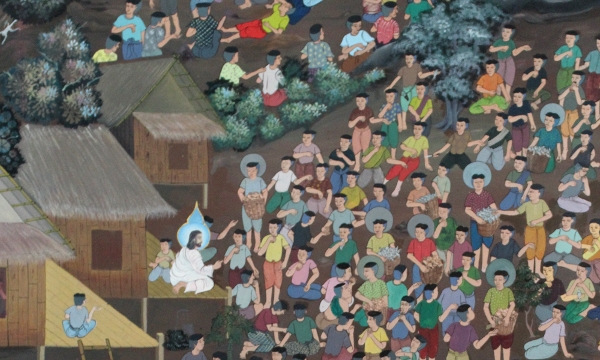
When I was first learning Thai, the meaning of the words jumped out at me: ข้าแต่พระบิดาของข้าพเจ้าทั้งหลาย is “Our Father” in Thai. It is long! But the length is exactly what drives home the point. It means something like “Great Father of us [set]”.
- The “Great Father” is the father of a group, but truly a father, like Abraham is father, or Adam; the language used is that appropriate for royalty or Buddhist monks.
- The meaning of the “our” or “us” in the Thai translation is the word “me” or “us”, followed by a word ทั้งหลาย, which means “the (entire) set” – the entire set of “us”. (Thai is a rather logical language, with sets and classifiers being not uncommon.)
Our Father is the Great Father of the (entire) set of “us”: us elevated by the greatness and royalty and priesthood of our Great Father – and only by that – into a high lineage that has only to do with our Father’s gifts. That’s a mystery to unpack for a lifetime – and for eternal life. That’s a mystery to experience and to throw us into the contemplation of Love. If we were recollected, able, or up to it, how “readily” could perfect contemplation come at this point!

 Contemplative in the Mud