
What is the death of a saint? It is a time when the last veil falls and, with little or no further purification (purgation), enter into the Church of Heave, without a body (for now) but seeing God now face-to-face.
Saint John of the Cross teaches that, for one brought nearly to the end of the spiritual journey, purged first as regards to the senses and then as regards to the deeper spiritual sources of the human person, the death is a kind of beauty. Those aren’t his exact words. But he speaks of the one who is “married” to the Bridegroom in such a way that one knows that, in peace, they pass into Heaven.
Is it so simple?
Yes and no, the saints tell us.
Yes, they are at peace in the higher parts of their soul.
No, because suffering may be agony. Agony, to be sure, for God’s beautiful will and for the salvation of many; but still agony.
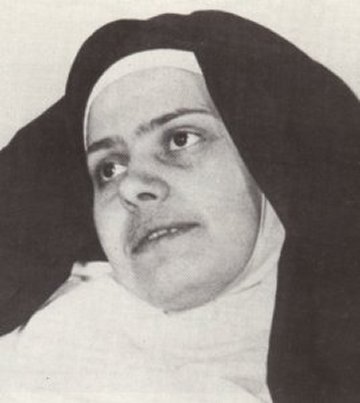 These two reasons put together are why Blessed Elizabeth of the Trinity, lying in the infirmary near to death, said that she understood why people committed suicide; but she herself bore everything in the throes of Addison’s Disease. These two reasons are also why Saint Thérèse warned her fellow-sisters not to expect anything as peaceful in her death as Saint John of the Cross speaks about; she is at peace, but her body may not be quite so much! This remains the secret of God. No words from even so sublime a pen as Saint John’s can take away the secret.
Does this mean that there are no links between the suffering body and the transformation and transfiguration made in Christians by Christ? Does the suffering and dying body lose its beauty that was transformed and transfigured in Christ?
No, of course not. But the suffering of death teaches us one very clear thing: the transfiguration of the body by the Light of the Spirit is not an aesthetic, emotional, or discussable-critical beauty. It’s a beauty of the integration of the human person and of the gathering-up of the whole human being into the Spirit, everything penetrated by his Light. It’s a mystery. A partially visible mystery, true! But a mystery nonetheless.
Going farther back than John, Thérèse, and Elizabeth, we can read about the death of another Western Doctor, Catherine of Siena; the body of the “Seraphic Virgin”
was by that time reduced to such a state that it seemed like a corpse in a picture, though I speak not of the face, which remained ever angelical and breathed forth devotion…
But it is not all “clean”, predictable, and aesthetically (anaesthetically) beautiful:
She employed the remainder of the time with many other formulas of prayer, both humble and devout, expressing various acts of virtue, after which her face suddenly changed from gloom to angelic light, and her tearful and clouded eyes became serene and joyous.
It is not so simple as to say that any particular emotional or physical state dominates. But, once transforming union with God is reached, the whole person remains integrated. This is true of the deaths of others like Thérèse and Elizabeth, just as it is true of the death of Catherine.
The transfiguration of the body by the taking-up of it, its gestures, its appearances, and all its activity by the Holy Spirit is real. It is real in the saints who reach the highest heights in this world. It is true for any of us starting on the journey. But the truly mysterious part of this mystery is that, through the peace and obedience which enable the Holy Spirit to take all our faculties and bodily acts up in his Light, not everything is necessarily beautiful by any merely human standard of judgment.
God will indeed “find an excellent means of taking [us] to heaven” with him, as another “little” spouse of Jesus (Marcel Văn CSsR) said. But to predict it? No, that’s not for us. United with Jesus and the Most Holy Trinity, the means will be excellent and beautiful and transfigured in some way. But to predict it or settle what it will look like is not for anyone but Providence.


 Contemplative in the Mud