
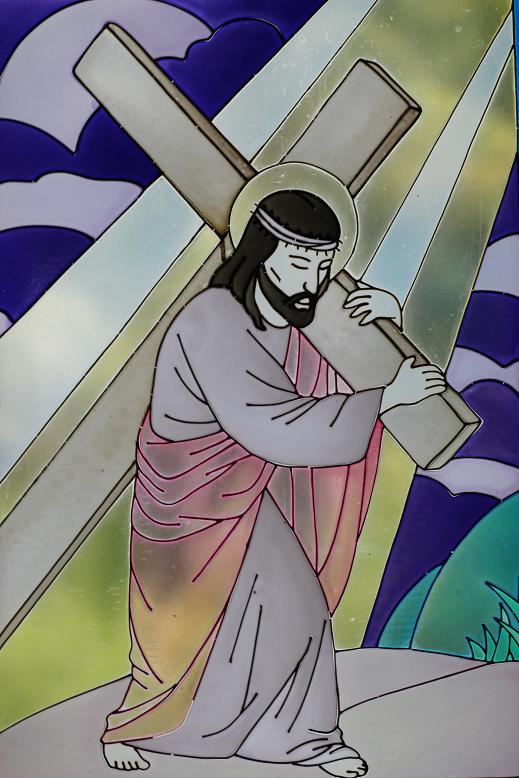
There is no way around it: you have to suffer. That is what Christianity teaches. Either in this life or the next, you have to suffer.
Unpopular? Maybe.
True? Definitely. You have to suffer. Either on earth, in Purgatory, or in Hell.
What Christianity really asks, though, is that we suffer in this life. “Be perfect,” says Jesus, “as your Father in Heaven is perfect” (Mt 5:48). Become perfect like your Father through, in, and with Love. Love, love, love, like the Eternal Three. The trouble is, we walk very wounded following the first sin of our first parents. There are disorders gnawing through and festering within our whole human nature. To be sure, our humanity is not obliterated. But it is severely wounded.
To become perfect, then, is going to hurt. A lot. It is like C. S. Lewis said about inviting God in to live with us in our cottage; he then starts knocking down walls to expand our abode into a mansion. It is not without pain. it is not without suffering. The way for humanity is the same way that Jesus, in his Humanity, took: the Cross.
If we deny any of this, we lose everything. The transformation by grace involves – for us because of our wounded condition – suffering and darkness. To this truth, Jacques Maritain adds,
Whoever hears the words “Be ye perfect” must not expect his nature to be “perfected” in any more comfortable fashion. Should one entertain such expectation, even though it be only by diminishing his natural desires in order to cultivate them in peace, he will succeed only in atrophying his nature in order to suffer less.
If we aim too low, we get nothing. We get only a shrivelled-up, stilted, desensitized humanity. We get neither human nature nor the total transformation by grace.
Magnanimity is required.
Magnanimity is absolutely indispensable. We cannot ask to suffer too much for God (though we can ask in the wrong way and at the wrong season). The redemption comes to us through the Cross. Certainly, we are promised thirty-, sixty-, or a hundredfold even in this life. But the way is Jesus, who himself took the way of the Cross.

 Contemplative in the Mud