
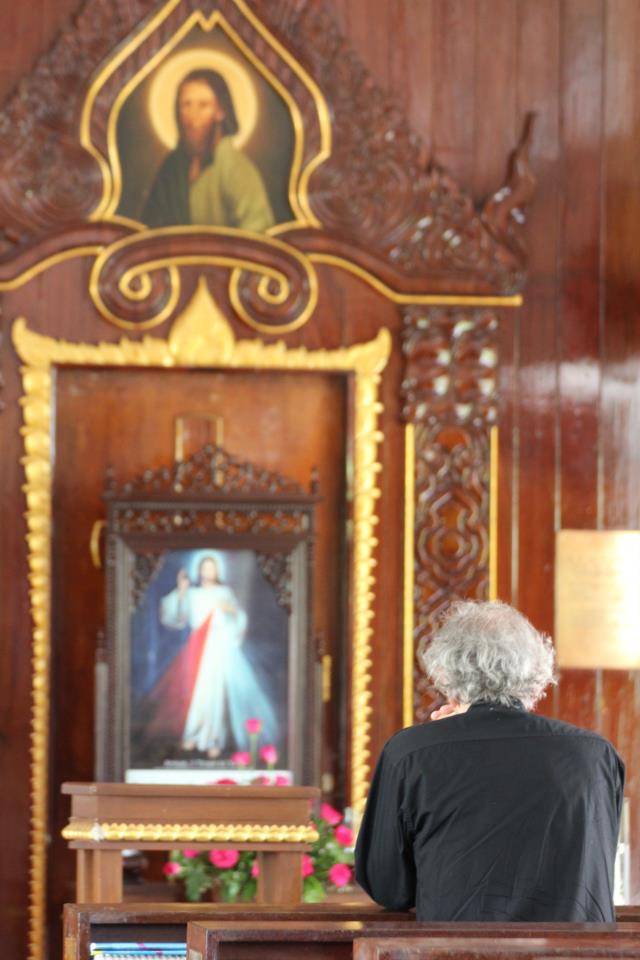
The Blessed Sacrament is a physical presence of Christ, hidden, as it were, behind a veil that the senses cannot penetrate, but only faith can discern. There is no doubt that the Eucharist has a profound link to physical presence. Just being there and just existing with Jesus in the Blessed Sacrament have a meaning that passes beyond words, in part because it is too simple for words, which are more naturally at home in the realms of images and ideas.
Presence and the Eucharist go hand in hand. There is a really profound reason why, for example, Blessed Charles de Foucauld dreamed of setting up tabernacles all over the land that he hoped would one day have missionaries appropriate to the needs of people. The reason is simply that presence and the Eucharist go hand in hand. And we’re talking about the presence of God himself, in Jesus’ humanity.
Presence and the Eucharist go hand in hand.
But there is a dimension to this that is related and intertwined, not only with our lives, but also with the lives of our neighbours. I think this is an implicit truth in much of what we say and think about the Blessed Sacrament. But we can make it explicit, too. Rereading Charles de Foucauld: Journey of the Spirit by Cathy Wright LSJ, I was struck by this passage:
There may be days when the only prayer we are capable of is to bring our bodily selves before the Body of Christ. In our flesh, we bear the effects of life. We do not so much reflect on what we are living as we simply present ourselves before Jesus. In a certain sense, the events of life make us who we are at a particular moment of time. And we don’t come alone. We bring with us the people whose lives are bound to ours, not so much in a manner of active intercession as in the solidarity that leaves its mark on our flesh and in our hearts… Our physical presence is our act of intercession.
Not all prayer is conscious. If God shoots a shaft of divine love into our soul, it need not all be consciously scrutinized, felt, vocalized, or reflected on. It can pass above our conscious perception (above, surely, not below).
In situations like these, our physical presence bears in it all the marks of how we, in our more conscious moments, have chosen to live our life. In the measure that we have chosen, with Jesus, to live with our neighbours and to simply and profoundly exist with others, we will also bring their lives, their concerns, and their ups-and-downs to Jesus in the Blessed Sacrament. In that sense,
Our physical presence is our act of intercession.
It is certainly not less than an act of intercession. It contains a part of intercession, because our lives contain a part of our neighbours’.
Of course, when we can do more than bring ourselves to Jesus physically, then we must! But if we cannot, then we can just place ourselves in the arms of our loving Father, and he will already know what concerns us and those with whom we share our existence each day.

 Contemplative in the Mud