
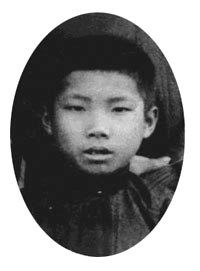
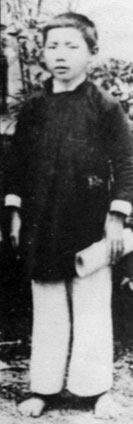
A young, late-teenage Marcel Văn used to talk with his “little Jesus” in a boyish way. They discussed anything and everything. In those Conversations, one of the topics is the will of God. In fact, the whole moral of the discussion is that if we become “God’s” to a rich enough degree, then it is God who more does our will than we do his. Is this shocking? Is this too much? Is this going too far?
Well, it is full of confidence and hope!
Here is the first such conversation; Jesus says to Marcel,
Marcel, you must understand that I follow your will more than you follow mine… In the eyes of your true Father in heaven, you are a little child; you love him always, you abandon yourself to him, you do his will and pay careful attention to it – conforming to it in everything… However, Marcel, your Father loves you more than you love him; consequently, he always wants to know your tastes and your wishes, to follow them as soon as possible. (371)
One example that Little Jesus gives is, unsurprisingly, that of human parents and their children:
If you examine the conduct of children towards their natural parents, you will see that it is like this. It follows therefore that the true Father in heaven follows even more the will of his children, than he allows them to follow his own will. Do you understand, Marcel? (371)
Since human children have human parents bend to their will, how much more does God who is Love bend to the will of pitiable, weak creatures like us! Put more succinctly:
Parents often follow their children’s will more than children do that of their parents. (372)
Children disobey; parents lavish love. It is as simple as this. God is not less. He is Good and he is Love.
 Later on, Little Jesus repeats the same ideas:
Marcel, you no longer belong to yourself, it is to me that you belong. Consequently, all I wish, you must also wish. On the other hand, when you wish something, you have the power to force me to follow your will… Because parents love their children a great deal and children, for their part, love their parents dearly, the results are that the will of the children is always stronger than the will of the parents… (467–468)
If we stopped here, we could misinterpret the fact that the one united in love to God can have “faith to move mountains” (Mt 17:20). We might wrongly interpret this to mean that God will grant us things to make our life “easier”. We might imagine that, united to God in love, we could, with a kind of mercenary love, ask God to lighten our load.
But, in fact, it goes the other way!
To be so closely united in one will with God, our love is no longer, of course, mercenary. We don’t want anything except to prove our love and to suffer for the accomplishment of goods for the one loved.
And all of this follows from the logic of the conversations of Little Văn and Little Jesus. Little Jesus then asserts the obvious conclusion. If, then, united with the Father in love, we suffer, it is because we will it – not, of course, for the sake of suffering, but for the sake of offering it to Jesus.
See, it is not from my will that your sufferings come, but really from yours, which wishes to prove its love to me. (468)
And again, just as surprisingly:
When the heavenly Father sends crosses to you, my little brothers and sisters, it is not his will that he is following, since his will already belongs to you; if he sends you crosses, it is because he follows your will which is in him. (469)
Externally, we bear suffering according to God’s will; but if we are united in one will with God through love and spiritual transformation, it is actually God the Father who is condescending to give us what we want: to suffer for him, to prove our love for him, to give him a little candy out of the treasures that he lavished on us, to love him dearly.
What wonderful closeness! It has a cost, of course. But what wonderful closeness: it can be said that the Trinity-God deigns to do our will more than we act to do the will of the Trinity-God.


 Contemplative in the Mud