
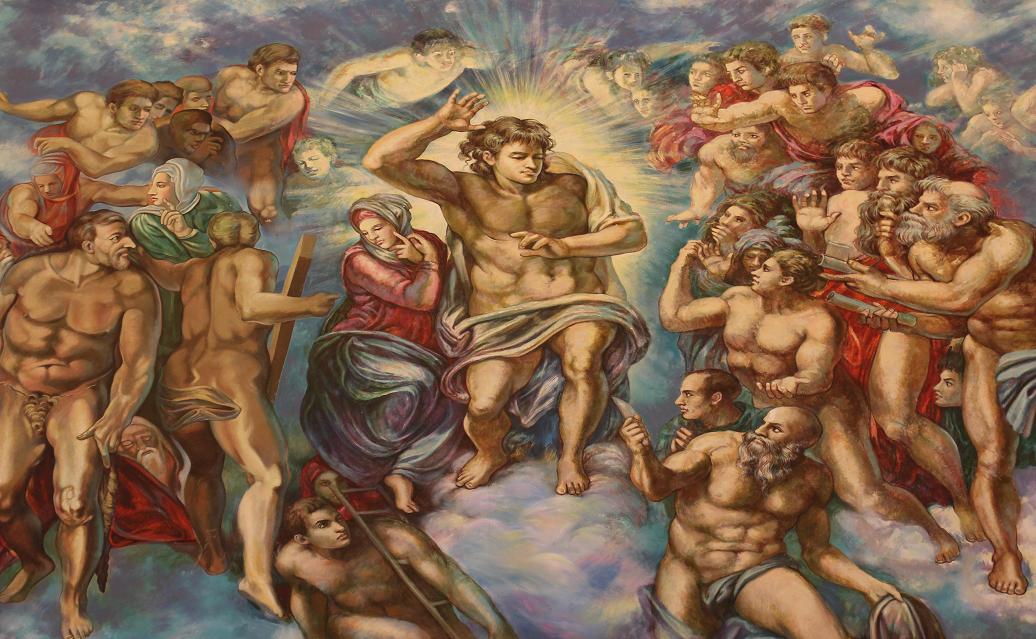
Magnanimity is not a virtue that I have in spades. (Anyone who has read this post knows it.) It’s only by charity, which is, as Thomas says, form of the virtues, that I can even approach the road of magnanimity.
But when one has one’s eyes focused on Jesus, it’s easier to be magnanimous. After all, dare to believe it! Jesus said,
Whoever welcomes one such child in my name welcomes me. (Mt 18:5)
And:
Truly I tell you, just as you did it to one of the least of these who are members of my family, you did it to me. (Mt 25:40)
And in the letter to the Hebrews (13:2), there is the claim that some, by their hospitality, have entertained angels without knowing it.
We’re to be magnanimous and let others be hospitable, kind, generous, and just to us. Saint Thomas teaches that magnanimity is a virtue. And Jesus clearly asks us to know that we bear a great honour, that we must be magnanimous: have confidence, be joyful, be assured, go, receive, do, simply be related to others as a brother or sister. Our neighbours have the great reward that, insofar as we have Christ in us and insofar as they, inchoately or explicitly, recognize it, they are interacting with Jesus! Let ourselves disappear. Let Jesus appear more. Be all the more honoured, magnanimous, and great for it. Littleness leads to greatness, not for our sake – but for the sake of Jesus and for the sake of others who have more of a chance to see him, interact with him, and do good to him through our presence.
This truly is wonderful!
It’s a surprising greatness!
Of course, we cannot get slack and stop doing to others as we ought to do. The virtue of magnanimity is not an excuse to be lazy or indifferent.
But still, magnanimity is a virtue. There are times when we must simply receive as someone honoured or to as someone to whom something is due. Blessed Charles de Foucauld learned this, slowly and late in life, when he was nursed back to health by the Tuareg among whom he had made a home in the hopes of “bringing Jesus” to them. It turned out that, when famine and drought struck, he needed them. It wasn’t all about him giving. They gave. He received. This made them more brothers and friends. This was turning point for Charles. He learned something new. His friendships deepened. Why? In the first place, it’s just human to receive, as well as give. In the second place, one has to allow that it was an opportunity of grace for Charles’ friends: helping Charles, helping Jesus in Charles!
We must receive: receive as Jesus, in the evangelical littleness that makes us great, because it makes us more like Jesus, to whom our neighbours’ actions then become addressed. This is precisely what the parable of the sheep and the goats tells us: the “nations” (goyim, גוים) will be judged by what they have done to those in whom Jesus visibly and clearly lives. One of our jobs as Christians is to facilitate the work of non-Christians by being more like Jesus and being closer to our neighbour. In short, we have to be little, but magnanimous.

 Contemplative in the Mud