
Yesterday I touched on one theme of transfiguration that is clearly common to mystical theology in Eastern Christianity and in Western Christianity.
There’s another theme of transfiguration that clearly cuts across East and West – I’m sure there are many, since transfiguration is a theme of the whole of Christianity – and that is the theme to which Saint John of the Cross gives words like this:
Mine are the heavens and mine is the earth. Mine are the nations, the just are mine, and mine the sinners. The angels are mine, and the Mother of God, and all things are mine; and God himself is mine and for me, because Christ is mine and all for me. (Sayings #26, 27)
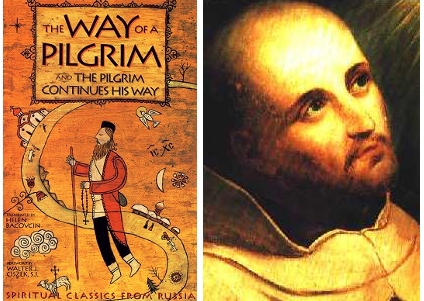
Similar meaning underlines several passages in the 19th-century Russian spiritual classic The Way of a Pilgrim:
When, while praying at the bottom of my heart [it is a contemplative union and a constant repetition of prayers like a drumbeat in one’s mind and heart], everything around me appeared under a ravishing aspect. The trees, the air, the birds, the earth, light, all told me that they existed for man, that they witnessed to the love of God for man, all prayed, all sang the glory of God.
What does the theme mean? Why, that the one who has been humiliated and humbled and who has let God take the lead – from the summit of her soul down to her fingertips – “possesses” Christ like a lover! To be sure, a poor, fragile, dependent lover. But a lover nonetheless. It’s the “mystical marriage” spoken of by Saint Teresa or by Saint John of the Cross. One simply loves. And in love, when our heart is simple and undivided, one looks on Jesus. United to the humanity of Jesus, in one person, is God. And what love God pours into all his creatures…! Can’t we, at least faintly, hear it?
Didn’t Saint Francis speak of his Brother Sun and Sister Moon?
How could that be unless his whole self, body and soul, were transformed or transfigured, too? “God himself is mine and for me, because Christ is mine and all for me.”

 Contemplative in the Mud