
In the spiritual life, there are often two poles: like the north and the south poles. We gravitate towards, now one, now the other, of these poles. This isn’t to say that, being at one pole, we are excluded from its “opposite”. It’s just to say that that’s where we are, though we may be slowly being attracted again to the second pole. As long as we are in the spiritual life, we’re never out of the influence of either pole. Some weeks, some days, some hours, the north pole pulls stronger; the next week, day, or hour: the south pole.
What are these poles that I’m thinking of?
The first two poles are action and contemplation. All Christian lives involve a certain amount of action and a certain amount, if the things of the spirit can be called an “amount”, of contemplation. The Gifts of the Holy Spirit guide us now one way, now the other, and both the three contemplative Gifts (Wisdom, understanding, Knowledge) and the four active Gifts (Fortitude, Counsel, Piety, Fear of the Lord) are necessary for and given to each Christian. When we are drawn to the pole of contemplation, no matter how long we are there, the pole of action is still drawing us in some way. Indeed, it may come surprisingly fast that we seem totally under the influence of action! And then, when the urgent necessity of action dies, we retreat to God in contemplation. We’re drawn to the other pole. We don’t write the rhythm. God, in his historical plan, does that. We just listen, obey, and take what comes our way in a spirit of littleness.
The next two poles I’m thinking of exist within the pole of contemplation. Within the pole of contemplation, these two further poles are God in himself and God in our neighbour – or, put another way, contemplation in solitude and contemplation in the world. Contemplating God in himself is what makes possible contemplating God in our neighbour. We cannot have the second without the first. In the order of values, contemplating God comes first. (This is why Blessed Charles de Foucauld first discovered being alone with Jesus and then, after many years, realized that he could also be with Jesus in his friends, neighbours, and brothers. He first had to learn, as we all first have to learn, to love God in himself, as Father, as Son, as Spirit. Only if we are friends with God will we be a sister or brother to our neighbour; at least, when everything is clearer.) However, both poles are real. While we are sometimes more under the influence of one and sometimes more under the influence of the other, both influence us simultaneously. Seeing Jesus in others is truly contemplation, too. We humbly take each pole as the Spirit and as circumstances and possibilities lead.
The third pair of poles I’m thinking of lies within the pole of contemplating God in himself (contemplation in solitude). Within the pole of solitude with God, there are two poles: contemplation secretly vivifying meditation or discursive thought (including theological reflection) and totally silent experience of God’s love. Sometimes our mind is racing, learning, or putting things together step by step. Sometimes our mind is just being overwhelmed and taken by the Trinity, who dwells in us and speaks to us in knowledge beyond human words. These, again, are two real poles. Both happen in silence with God; but one is discursive (and tending towards contemplation and being secretly sustained by a kind of masked contemplation); the other is purely, totally contemplative. Here, the better of the two is contemplation proper (totally silent experience of God’s love). However, we cannot do without either one, if we are really to have a spiritual life. Both poles are necessary. Sometimes we are more under the influence of one, sometimes more the other. Again, we don’t choose. When the silent approach is made available by God, we must take it. When it is not made available, then we take the other route, always paying attention to the changes in how the wind blows.
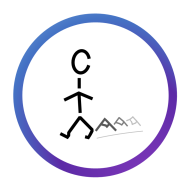
Six poles: two within one, which is one of two, which are within one, which is one of two. I’ve sketched this in the figure at the top of the page.
Is it possible to sketch the things of the spirit? Well, I don’t know. Of course it’s deficient. It doesn’t measure up. It only captures a part. But Saint John of the Cross did it. And Jacques Maritain, too. So I’m not exactly in bad company…!


 Contemplative in the Mud