
I’ve previously asked, maybe a bit impertinently, “Where does contemplation go when our head is busy?” The last time I asked the question, I put it from the point of view of the Christian operating under the regime of the Gifts of the Holy Spirit.
Can I be a bit more impertinent this time? I want to ask the question about Jesus.
Yes, I know it’s a bit impertinent.
What happens if one asks the question about Jesus? Where did contemplation go, in Jesus, when his head was busy?
I don’t think it’s satisfying to say that, at any particular time in Jesus’ life, he did not have a contemplative gaze on his Father.
No, I won’t have that. It’s just impossible. Contemplation, passio divinorum, was a constant reality in Jesus’ humanity. If it were not, then why could the Church’s constant tradition, including the present Catechism, place such value on contemplative prayer?
But if it was a constant in Jesus’ life, does that mean his head was never busy and his energies directed at some task? No, because then he wouldn’t be truly human. Consider, if nothing else, just his childhood. Charles Journet wrote about this wonderfully and simply:
The child Jesus will grow; he’ll know the cold and the heat; he will discern colours, the blue of the sky or those of flowers, discern traits of faces… All these things, he saw them, felt them, with a human tenderness that surpasses all the great geniuses and all the great artists…
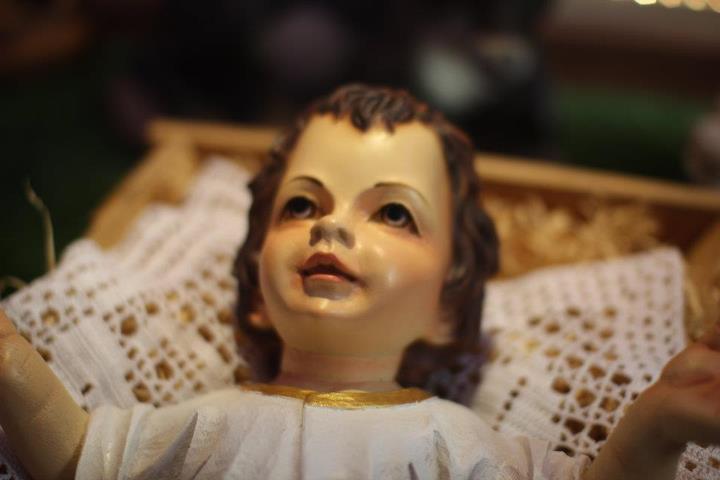
This is the Christmas of Saint Francis! This is the humanity of Jesus! It’s really his humanity, in all its growths and human inabilities. Little Jesus was lying in the crèche. Of course, his mind was not consciously contemplating his Father then. He had to grow and learn.
But at every moment of time, his mind was contemplating his Father.
It didn’t have to be conscious. But it was contemplation.
Can we perhaps perceive why Christianity shook to the very core the Gentiles’ classical opinions of contemplation? The Greek philosophers wanted repose in contemplation, but they thought any distractions were unworthy. The Indian tradition wanted contemplation, but concepts were held less loftily than in Greece. This background appreciation or view of concepts was, of course, carried in the Buddha’s time and expressions.
Only Christianity handled these problems head on: yes, concepts and thinking; but no, work and distractions do not make us unworthy. Why? There can be a deep, meaningful inner repose that doesn’t rely on external circumstances. Why? Well, we get down to it: God himself was born a little child, lived as a labourer, learned ideas and words, and always lived in the full presence of God. If we’ve digested this, we can definitely, in the long run, side with neither the ancient Greek nor ancient Indian traditions.
Jesus, in his humanity, was susceptible to the weaknesses that are simply human in nature; I don’t mean any of those weaknesses that are a result of our sins or others’, but there are human weaknesses that are just our nature. And a perpetual inability to be physically and consciously reposed is one of those traits of human nature. Where, then, was his contemplative gaze on his Father? Cardinal Journet answers,
As regards the lower regions of his soul, his senses, and also his body, all of this was vulnerable. I said that the tide of human suffering and agonies could pass over him, but even at the most tragic moments, when he was bloodied, crowned with thorns, and presented to the crowd, when Pilate said, “Here’s the man,” there was always in the summit of his soul a firmament of serenity… Even at those moments, the summit of his soul remained in paradise.
Jesus’ constant contemplative union with his father was in the summit of his soul, like the upper part, like the window through which heaven enters. This is something about human nature! Not everything about us is conscious. Conscious activity doesn’t even have to be the best. It often isn’t! Often the best part of us is beyond our own recognition: take courage!
These higher regions of the soul, the heart, the spiritual unconscious regions, are what gives us hope when we feel weighed down. We know God has not left us. He may be right there, at the summit of our soul, holding onto us with love and contemplation, if, in our actions, we still let him. This is an amazing, wonderful gift. We can fall back on Love. Always.


 Contemplative in the Mud