
The only time that Saint Thomas exactly uses the phrase “passio divinorum”, suffering divine things, in his Summa, he says,
By “suffering” divine things is meant being well affected towards them, and united to them by love: and this takes place without any alteration in the body.
The first half of this statement is wonderful. The second half is not so wonderful. What Thomas obviously means is that “this takes place without any alteration in the body necessarily following a particular mode in a particular subject.”
Or if he didn’t mean this, I’d say, “Saint Thomas – not so fast!”
In point of fact, charity does or can transfigure the whole person, body and soul (see this excellent book by Father Le Guillou). Love is applied by God to the soul. It immediately takes hold of the best parts of us. Because that’s where it’s applied, there is no necessary link in any particular way between the soul, especially in such high, spiritual effects as love, and the body. It’s impossible to say how a person will be or can be transfigured by love. This is a secret. It’s a divine secret. How things overflow from the soul into the body is a secret. It’s especially a secret to the one suffering it, especially the more deeply and selflessly she suffers it.
But it is possible to say that a person will be or can be transfigured by love. For example, Saint Paul writes,
… we are always being given up to death for Jesus’ sake, so that the life of Jesus may be made visible in our mortal flesh. (2 Cor 4:11)
Do we doubt it’s possible? Just look at the face of Saint Thérèse or Blessed Elizabeth of the Trinity or Blessed Charles de Foucauld. It’s there. It’s real.
It just takes a look at the following picture:
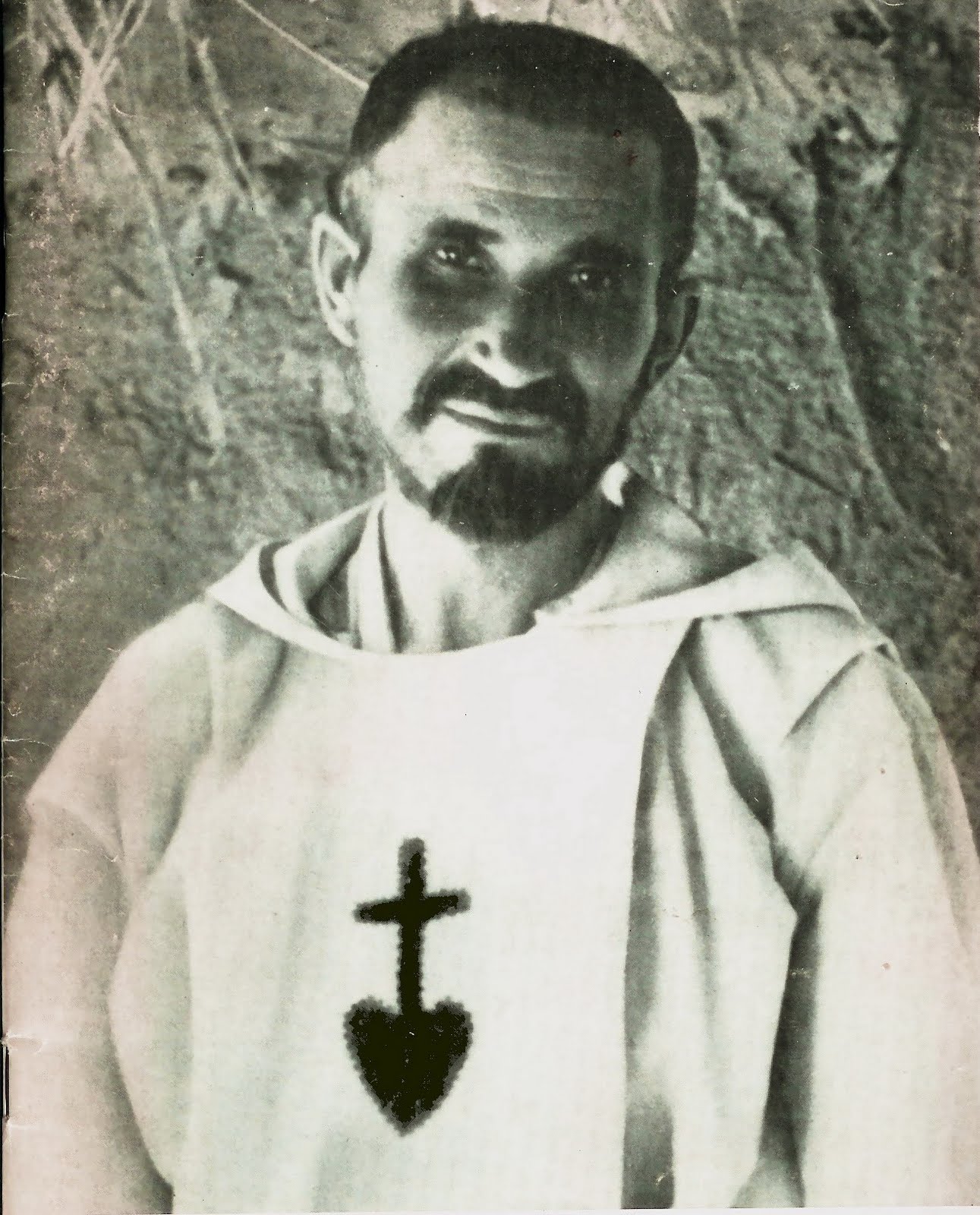
There are people who say, with varying degrees of seriousness, “Who is he?” “Is it an icon?” “How did they get a photo of Jesus?”
It’s a beautiful reaction. A true reaction. A profound reaction. There’s something about the face of this man, Blessed Charles: particularly the eyes. Love comes from or through them. It is not just a human appearance.
In point of fact, the transfiguration of the whole person, body and soul, by charity is a theme of the whole Church. To be sure, it is particularly strong in Eastern Christianity. But it’s universal. It’s a very strong theme in Saint John of the Cross, too. One of many clear examples is in the Living Flame of Love:
The very fire of love that afterward is united with the soul, glorifying it, is what previously assailed it by purging it, just as the fire that penetrates a log of wood is the same that first makes an assault on the wood, wounding it with the flame, drying it out, and stripping it of its unsightly qualities until it is so disposed that it can be penetrated and transformed into the fire. (St 1, #19)
Or:
When he wills to touch somewhat vehemently, the soul’s burning reaches such a high degree of love that it seems to surpass that of all the fires of the world: for he is an infinite fire of love. Because the soul in this case is entirely transformed by the divine flame, it not only feels a cautery, but has become a cautery of blazing fire. (St 2, #2)
Such a burning does not destroy, it divinizes and “burns gently”. It’s impossible to imagine a transformation of the soul so total that it has no effects on the body.
This transfiguration of the whole person by love is believed by Christians.
In our day, we have photographs of saints. We can see transfiguration by love, too. We can witness it. We can witness it in the beatified and canonized saints; maybe once we witness it in them, we can witness it in faces we meet.
We can pray that our appearance, our gestures, our habitual changes in body accompany the same rhythm as God’s preparations and activity in our soul.
Does passio divinorum “take place without any alteration in the body”? “Saint Thomas – not so fast!” ^^


 Contemplative in the Mud