
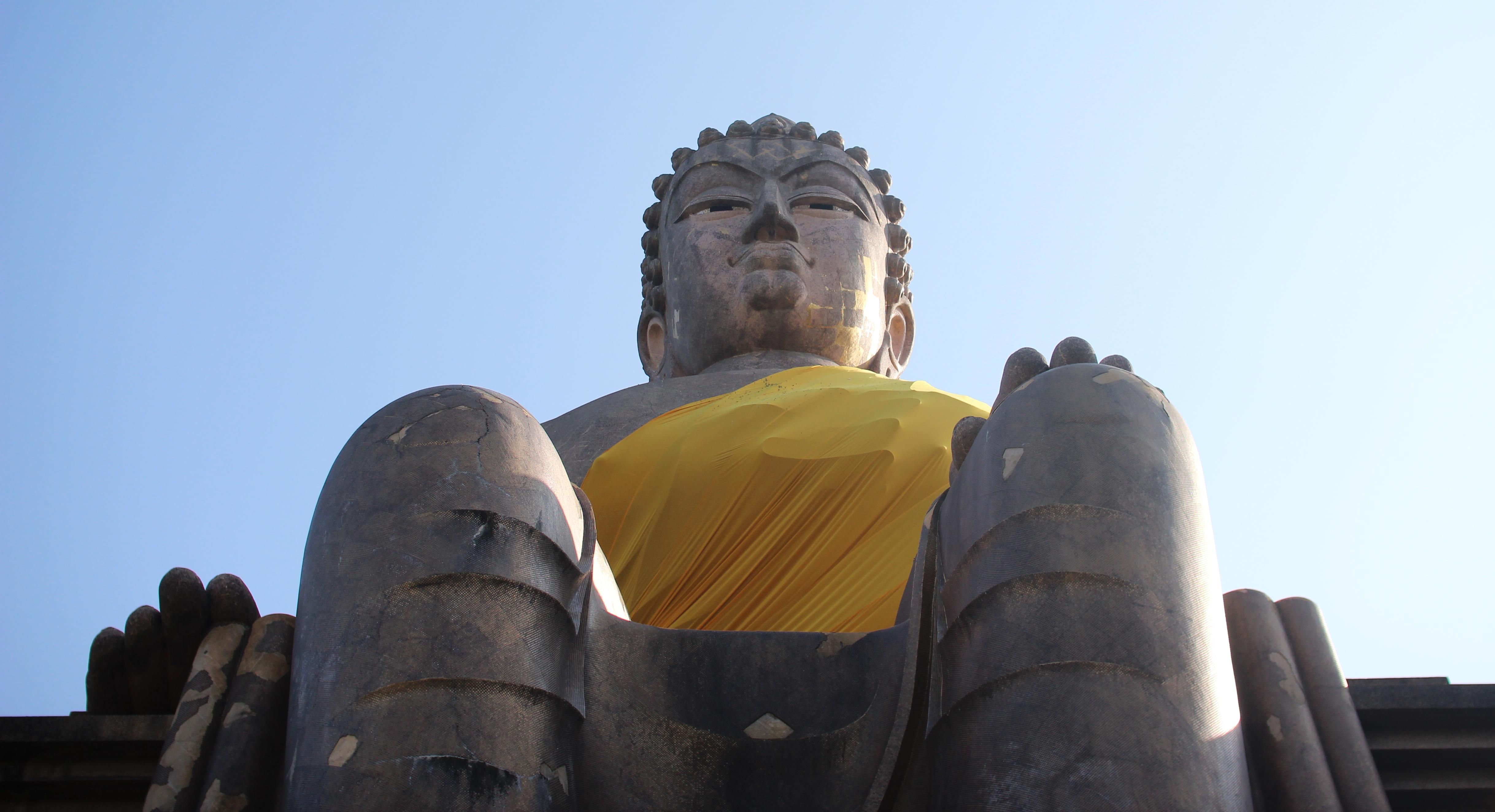
I live in a predominantly Buddhist country. Maybe it’s strange that I don’t talk often about Buddhism in relationship to Christian contemplation. Maybe you’ve asked why I write a lot, but rarely about Buddhism. Why don’t I?
Part of the reason is that I don’t have much to say. I don’t often get to reach my head out of the mud long enough to ask these kinds of questions.
Another reason is that, in comparing Christianity and Buddhism, I think we’re often talking about two scales of values that are incommensurable in theory, but which may, more or less often, cross into one another, depending on the working of the Spirit obscurely in the secrets of hearts. In other words, the concepts don’t seem to be on the same plane – but the people using those concepts might be. In this case, it’s often better to keep silence. Don’t put your foot in your mouth. Don’t be less than a neighbour, less than a brother, less than a friend. If you say too much, you might have to eat humble pie later.
Today I’ll risk a slice of humble pie.
Why do I think the concepts in Christian and Buddhist spirituality are not necessarily on the same plane?
Take mindfulness for example. This is one of the few Buddhist teachings that I profess any grasp of. I learned most of what I learned from Thich Nhat Hanh:
When we are mindful, deeply in touch with the present moment, our understanding of what is going on deepens, and we begin to be filled with acceptance, joy, peace and love.
Or:
Root out the violence in your life, and learn to live compassionately and mindfully. Seek peace. When you have peace within, real peace with others is possible.
Or:
The present moment is filled with joy and happiness. If you are attentive, you will see it.
Being “mindful” is “being present to the present moment”. In the language of Thich Nhat Hanh, this is a goal or term which brings with it an abundance of other good things: real peace, joy, happiness, love, understanding.
Meanwhile, in the language of Christian spirituality, “mindfulness” or “being present to the present moment” is a moral prerequisite to any sort of intermittent or sustained union with God by contemplation. In discovering the problem of a lack of mindfulness in the present age, René Voillaume writes,
… a certain number of religious and also lay people have not yet discovered the appropriate asceticism for keeping, in the world, a mastery of self and thus the possibility of contemplation. I think we can define this necessary asceticism as the acquired aptitude to maintain such a psychological, nervous, and physical state that we can be spiritually attentive to the present moment… We become incapable of living in the present moment, because we… are not sufficiently detached… in a word, because we have lost control of our self.
It has to be underlined: asceticism, detachment*, and mindfulness are not contemplation in the Christian sense: suffering divine things, love of God given by God to make us more like God. Asceticism, detachment, and mindfulness are only moral prerequisites for contemplation – but, no doubt, prerequisites worth insisting on in a fast-moving world that works against silence and recollection.
Is it clear why I think we’re using words in ways that don’t easily go together?
For Thich Nhat Hanh and many Buddhists, mindfulness brings with it an abundance of other good things. Now, practically and subjectively speaking, this might be true; things like joy have both human and divine origins, and we could never presume to judge the secrets of hearts. But in theory, no, I don’t think that’s true at all, because it’s like putting contemplation at the service of mindfulness.
Meanwhile, for the Christian, mindfulness doesn’t bring with it anything; it’s “only” a moral prerequisite for a more intimate, extreme, and self-alienating divine action in the soul. It’s the baseline and substructure (incomplete, of course, without the structure and superstructure of contemplation and divine union itself). Actually, from the Christian point of view, the description might be backwards. The Spirit’s actions might bring with them mindfulness or perfect mindfulness in its moral value. In this sense, Saint Teresa says that
detachment, if practised with perfection, includes everything.
But she does not say that detachment brings perfection; she says that when we act perfectly, detachment or mindfulness is full. To be sure, to say that mindfulness, which is a moral virtue, somehow brings things that are considered “fruits of the Holy Spirit” is, at best, a devotional difficulty. (After all, isn’t the Spirit a Person? How can I relate to a Person whose own fruits are “brought with” one of our moral virtues? That’s less than a Person…)
Practically and subjectively speaking, because of the inscrutable work of the Holy Spirit in human hearts, Thich Nhat Hanh may be right. I don’t deny any of that. Things might seem to happen that way, if not all the time, at least some of the time. But for the Christian wanting to know how to focus her prayers, her ideas, and her expectations? She needs to think in a different way, or else she’ll get nowhere fast.
– –
* I wrote a very little bit about detachment before: here.


 Contemplative in the Mud